

One of my earliest memories occurred when I was about two years old.
My family lived near the town of Port Elgin, a small tourist destination on the shore of Lake Huron, in a two-story apartment. The apartment comprised the front half of an old farmhouse, typical of those one finds throughout southern Ontario, Canada.
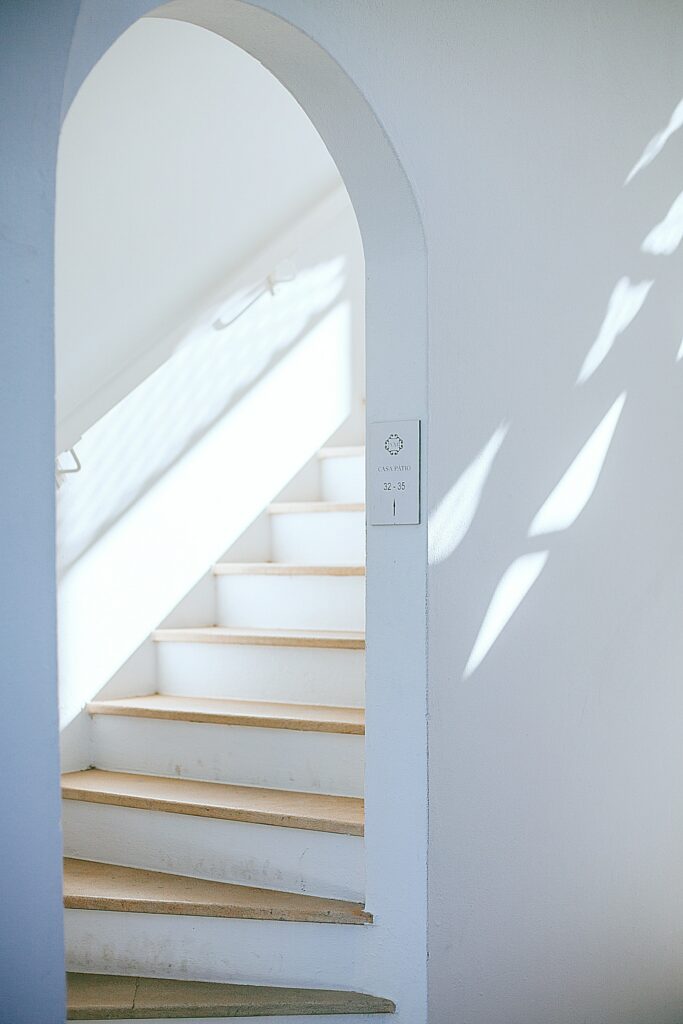
The farmhouse apartment had a stairway from the kitchen to the second floor. There were two steps to a small landing and about eight more steps leading to three small bedrooms and a bathroom on the second floor. A window at the top of the landing faced north.
On sunny days, a constellation of dust particles shimmered and danced at the top of the staircase in front of the window. I remember being mesmerized by the light show and how my mom indulged my delight by lingering with me on the landing so we could marvel over the sparkly scene together. I recall the sensations of awe and wonder, and I love that my mom paused her homemaking routines to allow me to enjoy such a simple experience.
I learned that climbing the stairs to catch the shimmering particles was an exercise in futility. I couldn’t see the pretty constellation if I got too close to it. The bits were best viewed from the landing. They needed space to shimmer and dance.
On cloudy days, dust in the air was not visible, so there was nothing to see at the top of the stairs. I doubt my toddler self was disturbed by the unpredictable rhythm of the absence and presence of the sunlight’s delightful effect. There is something to be said for appreciating beauty in its simplest forms and for feeling no despair in moments marked by its absence.
As an adult, I often fail to notice staircase ballets in various forms in my day-to-day life. Who has time to notice such things? We’re too busy buying books, taking courses, and perusing social media, relearning what we’re born knowing—how to find joy in simple things, how to be present, how to ground ourselves, how to heal.
A few years ago, a friend called; she sounded anxious. Her four-year-old son had developed a habit of lying flat on the floor when he felt overwhelmed, usually in a setting like a birthday party. She was worried he might be autistic or that people would see him as weird. “He can’t go through life lying on the floor because he’s uncomfortable. Have you had students on the spectrum who were successful in college?” she asked.
I assured her I had. I understood why she found it concerning that her kid hit the floor to cope with feeling overwhelmed. I also envied her son. I was impressed that a four-year-old child knew how to feel grounded in moments of anxiety or stress.
Think about it. How much money do adults spend searching for ways to regain a sense of groundedness in a world that never slows down enough for us to catch our breath? We pay people to teach us to be mindful and present and reconnect with our breath, bodies, and one another. In such practices, spirits find nourishment, resilience gestates, and creativity is born.
My friend’s son knew and practiced a form of self-care that many of us forget to remember and practice. This is tragic. If we believe that we were born to shimmer and dance and aspire to live accordingly, we must take care of ourselves. We have to notice what we need and give it to ourselves if we are to have what we want.
Not long ago, a decade-long relationship defined by betrayal, deception, and narcissistic abuse came to a predictably devastating end. Revelations of the extent of my former partner’s duplicity, including that he’d lived a double life the entire time we were together, left me shell-shocked about the gravity of his depravity. Remembering what transpired is still painful—imagining a future other than what we’d planned was almost impossible. Looking back was excruciating. Looking forward seemed pointless.
Months passed, but it felt like time was standing still. Eventually, in rare moments when I felt brave, I glanced up from the ashes long enough to see others who I knew had been to the dust themselves, daring to shimmer and dance.
I sensed these dancers had something that survived the flames, that darkness had not extinguished. What was it? I leaned in and saw that what they had looked an awful lot like courage. Courage may lie latent, I discovered, but it cannot be destroyed.
I’ve watched these dancers with awe and wonder as I once watched those dust particles in the sunlight. Each has fought her way back from betrayal, loss, and abuse and unearthed her desire to shimmer and dance. I’m so grateful for them because their stories are lifelines for others still searching for the courage to rise.






8 Responses
Absolutely beautiful xo
That was beautiful.
Very good. More than that, it’s good to know you’re writing again.
An arrow released well little sister! Bravo!
Beautifully written Linda! your words literally danced across the page!
Beautifully written, deeply felt. XO
Your writing is so vivid. I felt like I was standing on the landing with you. Thank you Linda!
This piece is awesome! Very touching.